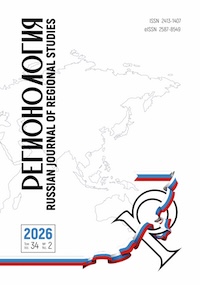
About the Journal
Russian Journal of Regional Studies was founded in October 1992 on the basis of the Research Institute of Regional Studies at the Mordovia State University (Saransk, Russia).
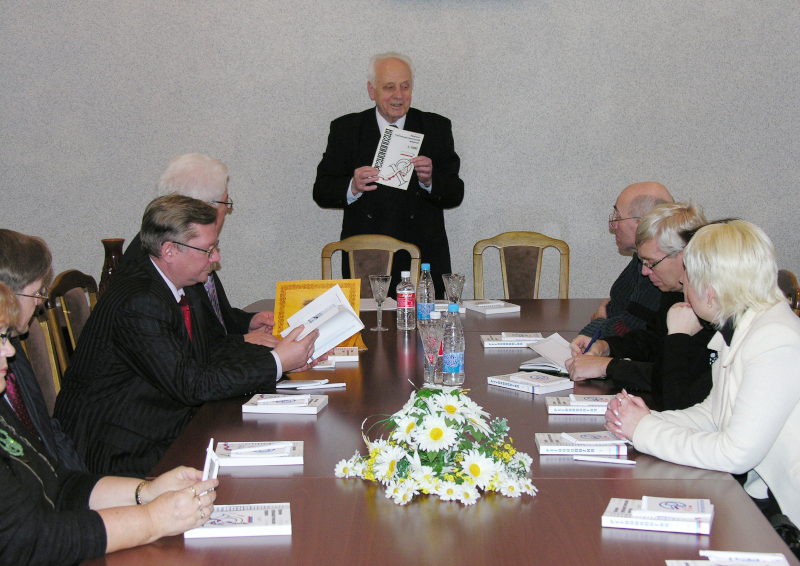
The initiator of the Journal's creation and its Editor-in-Chief for many years (until December 24, 2010) was the distinguished Russian philosopher and sociologist, public and political figure, Doctor of Philosophy Sciences, Professor Alexander Ivanovich Sukharev (1931–2010) . In the late 1980s and early 1990s, he developed the comprehensive scientific field of “regional studies”, which focused on the systematic study of the patterns of harmonious and interconnected regional development within a single federal state.
The Journal's mission is to publish original academic research that reveals the role of the region as an independent factor in socio-economic and political development. Priority is given to cross-regional and cross-country comparative approaches in the field of economics, sociology and political science.
The goals and objectives of the Journal are as follows:
- Promotion of comparative regional studies as a basic methodology for obtaining generalizable scientific knowledge.
- Publication of original scientific research in the fields of economics, sociology, and political science, demonstrating the influence of regional specifics on global processes.
- Support for publications on individual research cases, with mandatory justification for the choice of case in terms of its uniqueness or typicality.
- Strengthening the Journal's international visibility and its status as a platform for academic dialogue in the field of regional studies.
The target audience is researchers and academics studying issues in regional policy, economics, and sociology at the theoretical and empirical levels. The Journal is addressed to specialists, as well as experts from sociological and information-analytical services of government and public organizations.
The editorial policy of the Russian Journal of Regional Studies is based on the principles of free scientific inquiry. We support the right of scientists to openly conduct and present their research, engage in professional dialogue across disciplines and borders, and demand that their work be assessed solely on its scientific merits. By ensuring impartial peer review and decision-making, the Journal guarantees the integrity of academic communication and provides a platform for the fair evaluation and responsible dissemination of scientific work.
By adhering to these principles, the Journal's Editorial Board ensures the creation of a research environment in which academic freedom is fully respected, intellectual independence is protected, and scientific progress is determined solely by rigor, relevance, and ethical responsibility.
ISSN 2413-1407 (Print)
ISSN 2587-8549 (Online)
Founded in 1992
Registry Entry
PI No. FS77-85159
of 27 April 2023